

You’re planning your birth and you understand how momentous this sacred portal is.
You’ve noticed there is so much noise.
There are so many different birth education courses with lots of information about avoiding the ‘cascade of intervention’.
There seems to be an impossible list of things to be concerned about and watch out for… it feels overwhelming.
If childbirth is natural, should it be so complex?
What you deeply want is:
to feel seen and heard in pregnancy and birth through meaningful and respectful relationships
to trust your body and your baby - their inherent capability to birth and thrive
to make autonomous decisions that most effectively honour your unique needs and those of your baby
to find a supportive space where the noise drops away, allowing you to connect with your own inner voice
to be in your power as you enter motherhood or parenthood
This program is for the woman or parent who knows the importance of understanding physiological pregnancy and birth, yet realises there is something deeper.
“Knowledge is power, yet intuition is liberating”
A non-prescriptive program for parents seeking to experience the wisdom of pregnancy as the path towards birth autonomy.
Charlotte’s Story
Charlotte was a busy mother with a toddler and two businesses keeping her on her toes.
When she came to the program, she was feeling overstretched and overwhelmed.
Having had a traumatic birthing experience with her son, she was determined to do everything in her power to avoid a repeat. Her first step was to sign up for her local Community Midwifery Program (CMP) in the hope she could birth at home.
But Charlotte knew there was more to preparing for her dream homebirth than booking a midwife. She was ready to turn up the volume on the whispers of innate wisdom that would allow her to maintain self-assuredness and a knowledge of what was best for her and baby during her birth.
During our journey together, Charlotte overcame many challenges: crippling lower back pain during mid-pregnancy, the possibility of being ‘risked out’ of CMP on multiple occasions, the stress of winding up her business work and the exhaustion of a pregnancy with a boisterous 2 year old to care for.
At each stage, Charlotte was calling the shots.
Sometimes when we worked together, she was feeling frustrated with the healthcare system, so we used yoga to breathe and move through the emotions, so that she could redirect her energy to where it was more supportive.
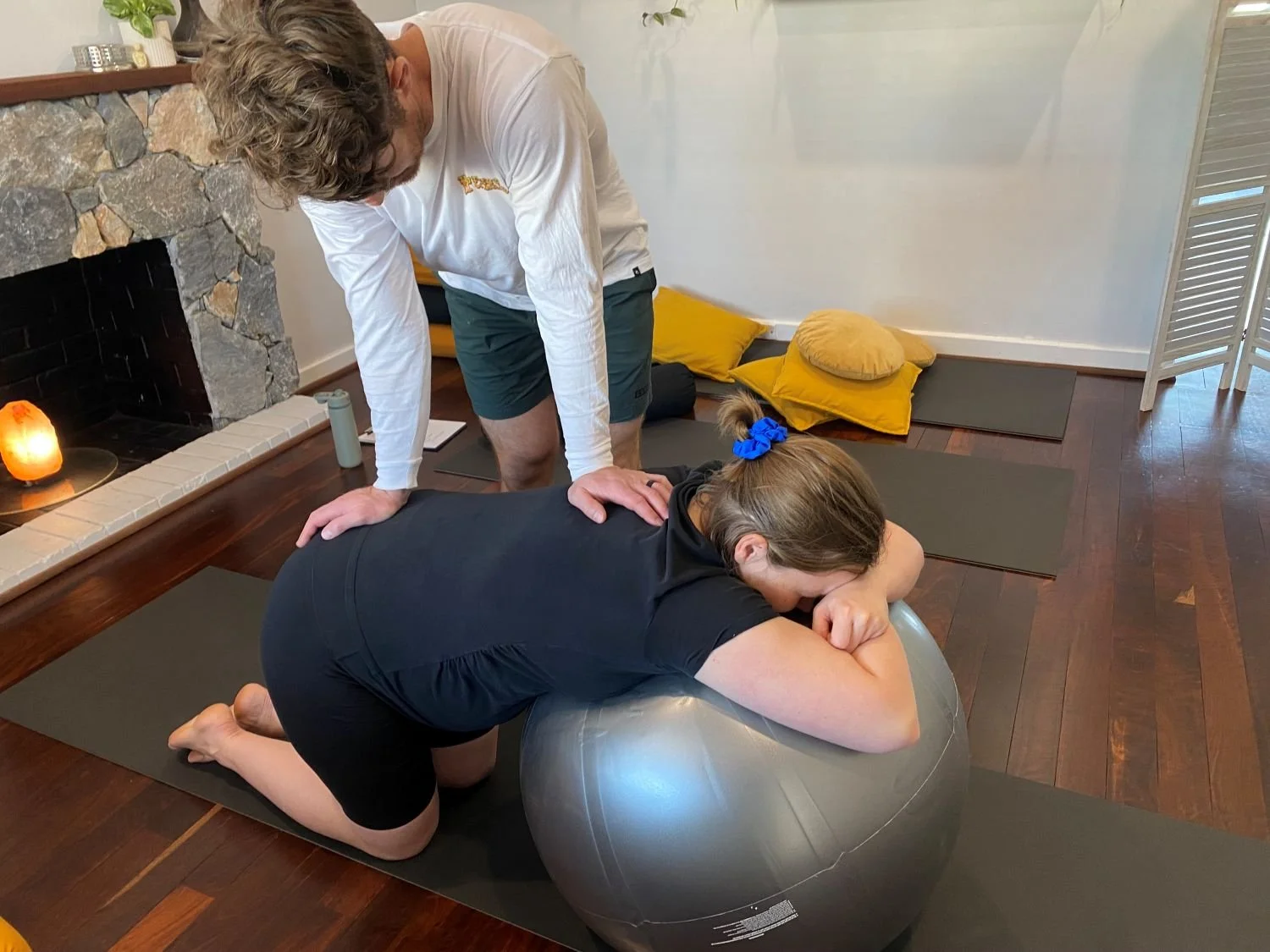
Sometimes she craved the space to connect with her baby, so we used ‘all the props’ to make the two of them comfortable and settled into a deep yoga nidra practice.
As Charlotte’s physical tension in her pelvis and lower back unwound, her assuredness blossomed. Early into third trimester, after a practice of deep introspection, she told me:
“I know there is no other way for me to birth this baby but at home.”
These were Charlotte’s birth highlights:
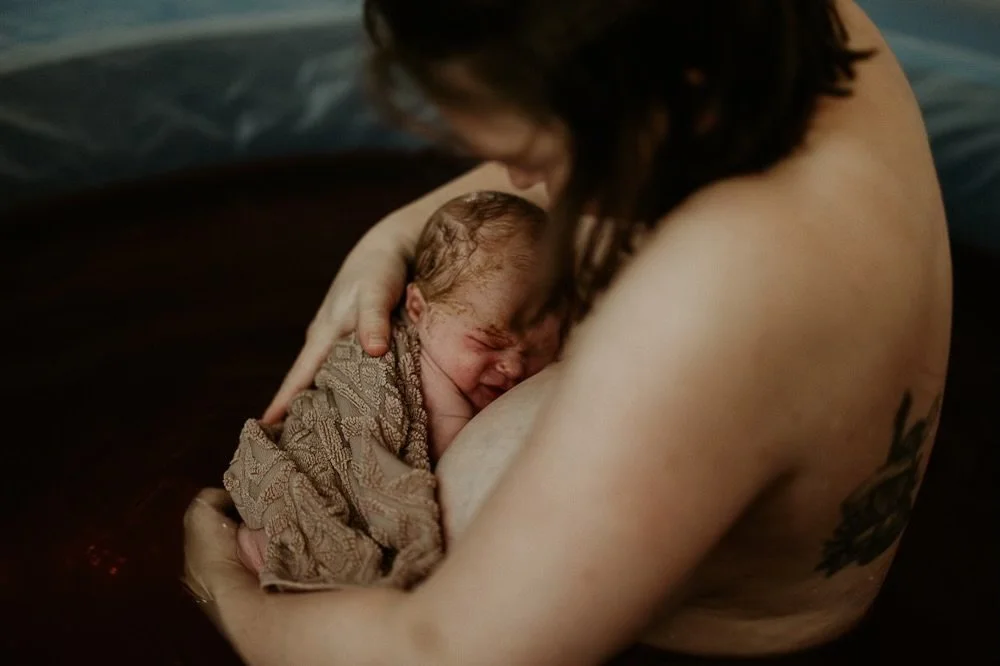
catching her baby in her arms as he entered the world
being fed poolside Malteasers by his older brother post-birth
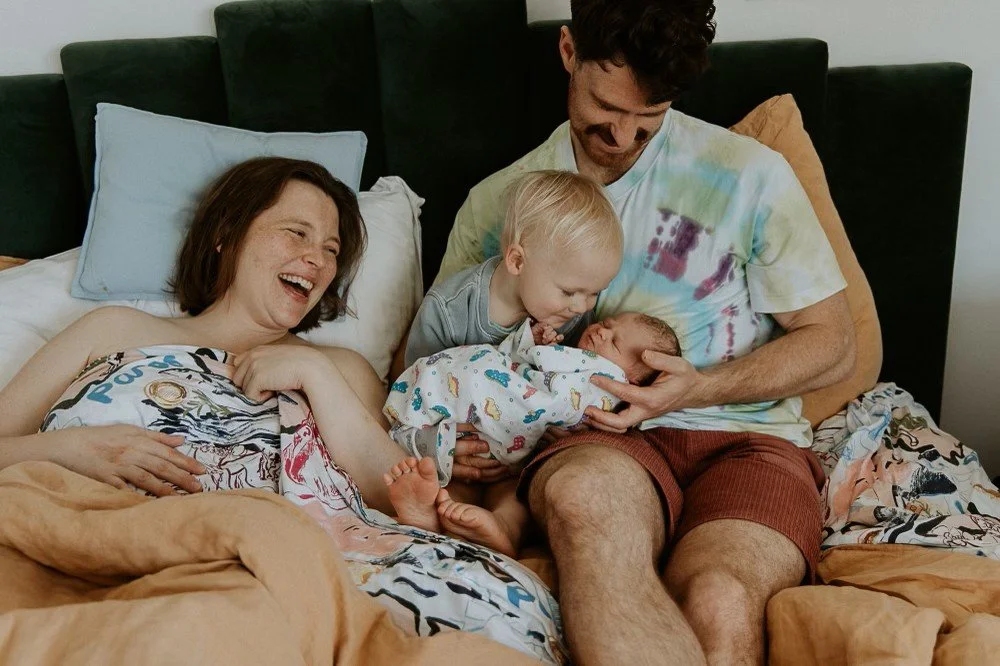
singing ‘Happy Birthday’ all cuddled up in bed over bub’s very first birthday cake, surrounded by loved ones at 1 hour old.

How can Yoga support Homebirth?
At its roots, prenatal yoga is not about pregnancy postures or birth positions.
Of course, having good range of motion through the pelvis is important, but it’s certainly not the magic bullet for natural birth.
Yoga means to unite.
It’s about working towards a clear connection with your Truth.
The part of you that knows exactly what is in the best interest for you and your child.
The part of you that is independent and autonomous.
“Choosing homebirth is an act of radical responsibility”
Why is homebirth radical?
Because it is a remembering.
A returning to a trust in the intelligence of the womb and the transformation of matrescence, through the portal of birth.
It’s one thing to understand what you and your baby need, but yoga is a foundational philosophy with time-tested practises that you can choose to help you express and fulfil these needs.
Yoga in action can support you to stand in assurance and self-advocacy, no matter what challenges birth and parenting present you with.
A non-prescriptive program for parents seeking to experience the wisdom of pregnancy as the path towards birth autonomy.
What you will Experience
This birth preparation program is unlike any other.
Rather than jam information into a few intense evenings or days, you will come to each new experience having had time for processing and integration of the previous one.
Rather than hyperfocus on the birth, we will help you will find the wisdom you need, right there happening for you with each step of your pregnancy.
What it Feels Like to Be Held in This Container
The journey of planning a homebirth is a radical reclaiming, and sometimes it can feel isolating or overwhelming. I created this weekly container because true growth requires not only a dedication to showing up and doing the work (tapas) but also having dedicated time to process and reflect.
My weekly, supportive presence is there to gently guide you to find personal harmony and trust the wisdom of your body, without needing to rush or feel pressured.
Facilitation Philosophy
'“I don’t teach you how you should position your body during birth, I support you to discover what it feels like in your body when you are in a position that creates space and allows opening.
I don’t tell you how to breathe for birth. I guide you to find your breath. The breath that will be right for you in that moment.
I don’t script the positive words you should whisper to yourself during birth, I walk beside you as you find those words on your pregnancy journey.
I don’t list every single intervention you may encounter, I hold space for you to learn what it feels like when something is right for you and when it is not.
I don’t answer all your questions, I empower you with the tools to find your unique answers.”

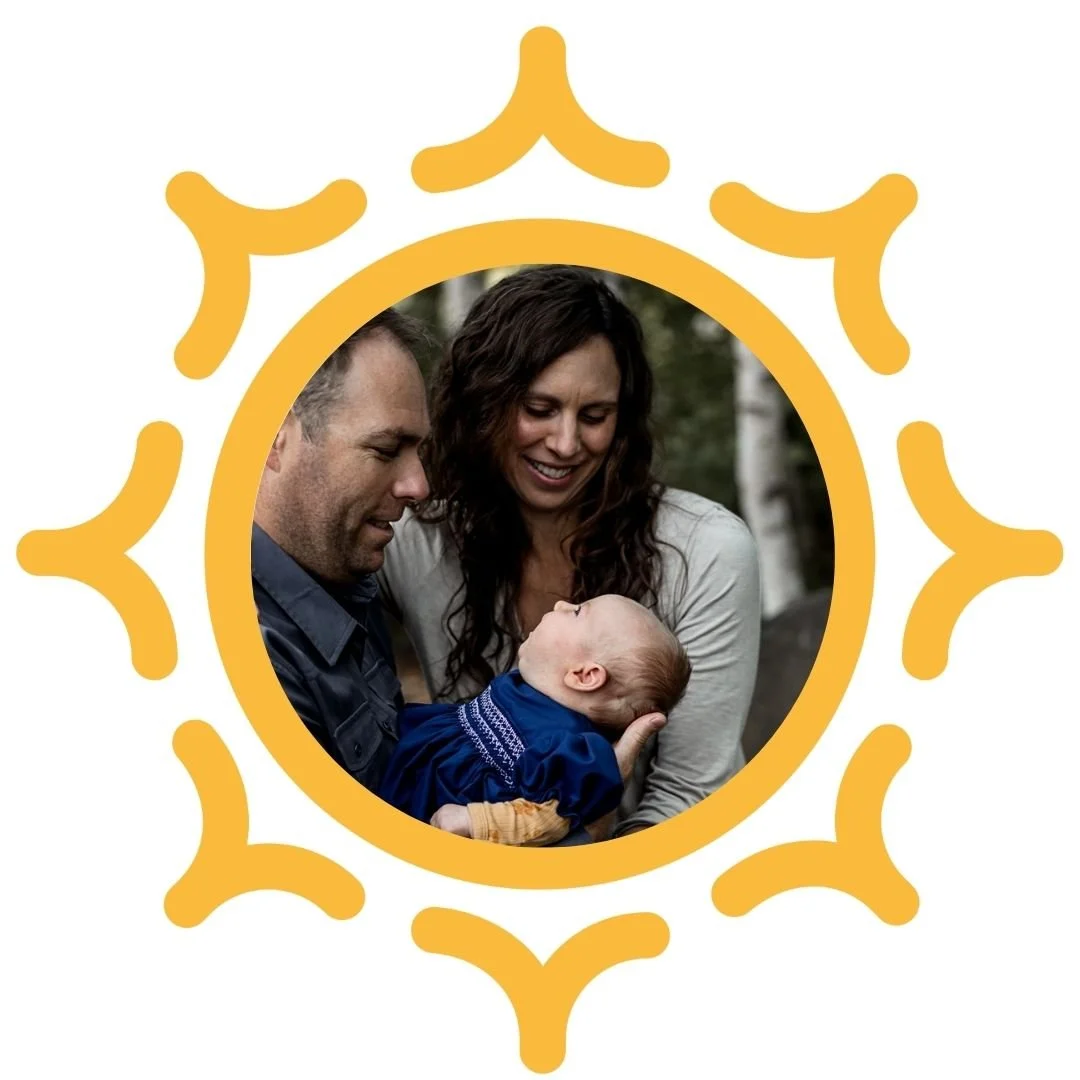
Claire Holloway
Yoga facilitator, perinatal and pelvic health specialist and matrescence coach.
About your Facilitator
Claire is an experienced group facilitator and yoga practitioner, movement and matrescence coach and pelvic health specialist.
She is skilled in translating and sharing traditional, time-honoured yogic wisdom in practical and accessible applications for the journey of matrescence.
She has personally experienced many of the possible physical challenges of the pregnancy and postpartum periods, including:
chronic pelvic pain
hip disfunction
foetal malposition
perinatal anxiety
Due to a breech presentation, she had an emergency caesarean section with her first pregnancy, followed by a homebirth-classed VBAC with her second child. (If interested, you can read more about her birthing stories here).
Claire is committed to a decolonised, inclusive and sustainable approach to sharing yoga and honouring matrescence. You can learn more about Claire - her experience and teaching commitments here.
Topics you will Explore
We follow the model of the 5 Koshas as a way to understand and support the entire being.
Therefore, every time we share yoga together in our sessions, you will experience practices to support each of your layers of being:
physical body (annamaya kosha)
energetic body (pranamaya kosha), often through the breath
mental health (manomaya kosha)
connection to your innate intelligence (vijnanamaya kosha)
connection to bliss (anandamaya kosha)
You can learn more about our 5 Koshas Model of Care here.
Each session includes practices spanning many facets of the yoga tradition:
Yama and Niyama: enquiry and reflection around your external and internal interactions
Asana: posture and movement
Pranayama: physiology and energetics, often supported by breathwork
Pratyahara: interaction with and withdrawal from the senses towards deep introspection
Dharana & Dhyana: focus, mindfulness and connection
Samadhi: independence and autonomy
If you’d like to get a taste of the look and feel of the program, jump in here for your sneak preview of Module 1: Embrace Space.

Course outline
The course is designed to be accessible no matter when you arrive in the program. So apart from the introduction, you don’t need to begin at Module 1, but just start whenever it best fits in with your pregnancy journey.
-
1 hour Live Introduction Session
the foundations of yoga as it applies to the perinatal period
meet your fellow homebirthers
-
The golden rule of prenatal yoga is: ‘create space’. We explore how to:
Prepare the Space
Create a Caring Space
Embrace Spaciousness
-
How to moderate your energy appropriate to your perinatal needs:
The energies of ‘doing’ vs ‘being’
Sthira Sukha: approaching challenges with steadiness and ease
Asteya: Generosity of Energy
-
Right relationship is fundamental to a positive birth experience. You will explore your relationship with:
Yourself
Your baby
Your partner or support person
Your lineage
-
Understanding theoretically how your body gestates and births is one thing, experiencing what that feels like in your body is what we will cover:
Svadhyaya (self-study)
Pelvic and birth physiology
The myth of ‘active birthing’
-
Sometimes we don’t even realise we have a choice. Sometimes our choices are clouded by our conditioning.
The chakras: processing emotions
Vijnanamaya kosha: accessing your intuition and wisdom
Decolonising your approach to perinatal care
-
Many people make sound during birth. Understanding the power of sound allows you to harness it.
Nada yoga: the yoga of sound
Specific energies are at play as the body prepares for birth.
Apana vayu: downward movement of energy
Pratyahara: withdrawing from external distractions, inward awareness
-
Much of what holds us back in life is fear. Simply identifying our fears is not enough. You will learn how to know them and process them:
The kleshas & fear
Aparigraha: non-attachment
Approaching pain
Homebirth as a radical reclaiming
-
A positive birth experience doesn’t require a positive attitude. It requires a familiarity with joy or contentment and a readiness to leave everything behind as matrescence transforms you.
Creative Reclaiming
Transformation
Samadhi as celebration

“I would recommend this program to anyone looking for true support and guidance toward having the best pregnancy and birth experience possible.
The wealth of tools and techniques provided totally exceeded my expectations, as did the fortnightly face-to-face sessions.
I had the opportunity to share in a safe space with likeminded, inspiring women.
I am now in the final weeks of my pregnancy feeling more prepared and powerful than I ever could have imagined, and I know this program played a vital role in that.”

“It brought me a lot more into my body than I expected. I really imagined it was going to be a process of stretching and movement.
But it was that anchor point for me, every fortnight, to connect and also to connect to baby. I got a much deeper understanding of pregnancy, and of the body.
It was like a ritual: I’d get the laptop out, I’d have my tea ready, my nervous system already knew ahead of time: it was almost like it had started to drop in beforehand.
It was like an exhale every fortnight... my little plug-in and then go on again, almost like a little top up: something just solely for me and baby.”
Is Yoga for Homebirth the right fit for me?
This program is designed especially for you if you are planning or contemplating a homebirth or freebirth.
Yoga for Homebirth is for you if you are taking radical responsibility for your pregnancy, birth and parenting choices.
To practise yoga is to learn experientially.
Learning through doing and reflecting allows an application of knowledge to real-life situations.
Yoga for Homebirth has been specifically designed so that you arrive at each new experience just when you need it.
How?
By understanding that the journey of pregnancy provides all the tools you need for birth, one step at a time.
Rather than fixating upon the day of birth itself, you are encouraged to learn from the journey, not obsess about the destination.
Still unsure if Yoga for Homebirth is right for you or worth your investment?
I would love to discuss your individual needs and answer any questions you may have, don’t hesitate to get in touch.

Expert Guidance
Led by our experienced yoga facilitator, pelvic health specialist and matrescence coach

Weekly Live Yoga & Coaching
1.5hr sessions (including recordings)

Printable Resources
4 detailed downloadable manuals: asana, pranayama, mudra and mantra

Homebirth Community
Private group to connect, share and ask questions

Audio Recordings
Hours of guided visualisation, meditation & relaxation

On-Demand Yoga Sequences
Movement for every aspect of your matrescence journey
Abundant Value
Live sessions - minimum value $984 value for 8 modules, but increasingly more the earlier you join the program!
(For example, if you join at 13 weeks into your pregnancy and participate every week, that is $3,321 worth of yoga and coaching support!)
On-demand audio and video - $210 value
4 detailed downloadable manuals: asana, pranayama, mudra and mantra - $200 value
Instant community - priceless
TOTAL VALUE: Up to $3,731
YOU PAY: $567 (or $189 per month for 3 months)
You SAVE up to $3,164!

A non-prescriptive program for parents seeking to experience the wisdom of pregnancy as the path towards birth autonomy.
Frequently Asked Questions

-
The earlier in pregnancy that you sign up for this program, the more you will benefit.
Ideally, you would start this program in second trimester, or even late first trimester. This would allow you to complete the 8 modules over 16 - 18 weeks with fortnightly calls.
However, if you are further into your pregnancy, additional off-week call options allow you to complete the 8 modules sooner, within 9 weeks.
Please do contact me if you are unsure about the timing, as I will most likely be able to make arrangements to accommodate you.
-
Very much so.
You will have access to each replay very soon after the live so that you can keep up to date.
Then, there are hours of on-demand content for your to work through, intended to support your home yoga practice and birth preparation.
You are always welcome to send in questions that I can answer live on the next call.
-
This program is a commitment - to yourself, your baby, your family and your matrescence journey.
You will need to allow 1.5 hours per fortnight to participate in the live sessions (or replays) as well as approximately at least 1 hour per week if you wish to gain the full benefit of the on-demand resources.
Of course, if you wish to practice more often, you can even make this a daily sadhana.
-
I stand behind the quality and value of this offering. I do not provide refunds, as you will have immediate access to on-demand material and recordings.
If you have to leave the course early due to an early birth or medical complication, many of the practices are still relevant to postpartum.
In these circumstances, you can contact us to discuss the situation and we will come to an equitable arrangement if you ended up unexpectedly having less than 8 weeks’ access to the course.
-
You will have access to ask questions during the live sessions or submit your questions if you cannot attend.
Claire will also check the online community at least once per week to answer any questions within the group.
Additional private consultations in yoga, pelvic health and coaching can be purchased and can be delivered either online or in-person if you live in Boorloo (Perth, Western Australia).
Autonomy requires Action
Autonomy means self-determination.
There are certain factors that are required:
an inherent capacity for self-governance
a clear understanding of your unique needs and desires
independence from external influences
Autonomy in birth looks like having the capacity to make your own decisions and set your own direction for your care and your birth experience.
This involves intention and accountability.
Are you ready to take action?

A non-prescriptive program for parents seeking to experience the wisdom of pregnancy as the path towards birth autonomy.
Course Schedule
Live Sessions are weekly, in an ongoing cycle through the modules and alternating between:
Thursday mornings 9:00am GMT+8 (WST)
Wednesday afternoons 3:30pm GMT+8 (WST)
You will be provided with the upcoming schedule of dates so you know which Thursdays and which Wednesdays the calls are when you sign up. Or contact us before you signup for a list of upcoming dates.
Optional ways to complete the program:
Choose one of the days and follow the course through the 8 modules each fortnight, to complete the course over 16 weeks
Attend each call weekly on Thursdays one week and Wednesdays the other week to cover all the modules over 8 weeks (as they are offset by 4 modules).
View some or all of the live calls as replays to fit the course in at times that work for you
Additional points to note:
you don’t have to start at Module 1 and the Introductory Call is available as a recording, so you can join us at any stage and just cycle back through the modules as they recur again.
on-demand material is available as soon as you sign up
recordings of the live sessions are available the business day following each live session.
*Live classes are subject to change at the discretion of the course provider. For example, there will be a 1 or 2 week gap over the summer, between late December and early January.
Consistent Live Support
This is your chance to step into a space where you can let go of the noise, where your story is honoured, and where the inner assurance you need for your autonomous birth is nurtured every week, both by your guide and your peers.
Add More Value

If you feel you would like more personalised support, we offer private online and in-person consultations.
Yoga or Coaching Consultation
For Preconception, Prenatal, Postpartum, Parenting and/or Pelvic Health.
Consultations include:
lifestyle and wellbeing discussion
private yoga class or coaching session
detailed home practice and wellbeing recommendations
guidance and personalised audio/video as relevant.
Perinatal Practitioners
Are you a Privately Practising Midwife, Doula, Birthworker or any other perinatal practitioner who supports people who are homebirthing?
If you support people on their parenthood journey in any way, I welcome you.
Joining our Perinatal Practitioners community provides you with access to regular information and inspiration regarding birth at home and matrescence in general. I offer semi-regular professional networking and development opportunities as well as the possibility to become an affiliate partner for Yoga for Homebirth.